

About This Page
This is a month-by-month breakdown of what golf season actually looks like in the Park City market. Opening and closing dates vary by year and by course. The information below reflects typical patterns based on historical data and confirmed 2025 opening dates. Conditions change with the weather and snowpack. Always confirm course status directly with the club before booking travel.
On This Page
- The Short Answer
- Month by Month on the Course
- The Elevation Advantage
- Course Opening Dates by Community
- Frost Delays and Shoulder Season Reality
- What Happens From November Through April
- What Golf Season Length Means for Your Cost Per Round
- Which Club Has the Longest Playing Season
- Frequently Asked Questions
The Short Answer
Golf season in Park City runs from early May through mid-October. That is approximately five to six months of play, depending on the year. Courses at lower elevations in the Heber Valley corridor, such as Red Ledges and Soldier Hollow, may open a week or two earlier and close a week or two later than courses at higher elevations, such as Promontory and Tuhaye.
Buyers coming from year-round golf markets like Scottsdale, Palm Springs, or South Florida often view this as a limitation. That framing misses the point. The five to six months you do play are in conditions that those markets cannot replicate: dry air, temperatures between 65 and 85 degrees, no humidity, and the longest daylight hours in the continental United States during June and July. Sunset does not arrive until close to 9:00 PM in midsummer, which means rounds that start at 4:00 PM finish comfortably with daylight to spare.
Month by Month on the Course
May: Opening Month
Most private courses open between May 1 and May 17. In 2025, Promontory opened on May 10, and Tuhaye opened on May 17. Lower-elevation public courses and Red Ledges sometimes open in late April. Conditions in early May are variable. Morning frost delays are common during the first two weeks. Afternoon rounds are the play. Expect temperatures in the mid-50s to low 60s. The courses are green from snowmelt, and the rough has not yet thickened. It is some of the best-scoring weather of the year, if you can handle the cooler mornings.
June: Prime Season Begins
June is when golf season fully arrives. Temperatures climb into the 70s. Daylight lasts until nearly 9:00 PM. The courses are in peak early-season condition, with greens running fast after spring aeration and recovery. Frost delays are rare by mid-June. This is one of the two best months to play in Park City, and it coincides with the mountain's quietest period, which means lower road traffic and easier access to everything.
July and August: Peak Season
Daytime temperatures range from 75 to 88 degrees. Mornings are cool enough to walk comfortably. Afternoons stay dry. Afternoon thunderstorms roll through periodically, usually clearing within 30 to 60 minutes. The courses are at peak condition. Tee times at private clubs are most competitive during these months, particularly on weekends when part-time residents are in town. If you are a member who plays primarily in July and August, expect the most demand on the tee sheet during this window.
September: The Best Month Nobody Talks About
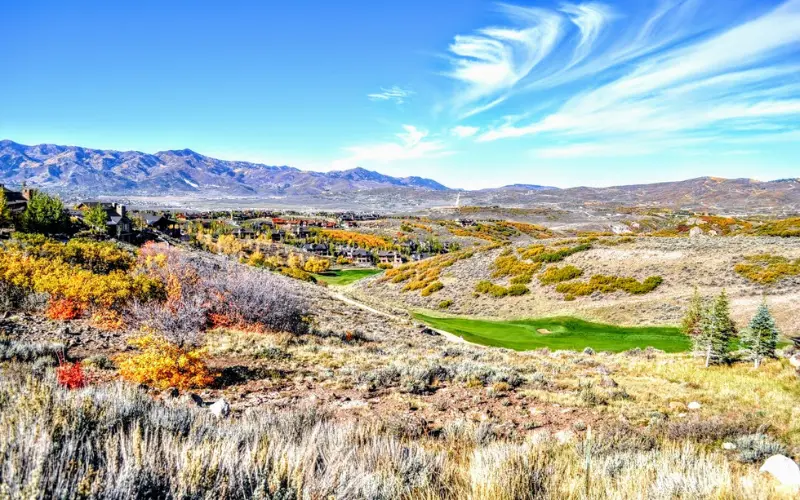
September is, by many accounts, the best golf month in Park City. Temperatures are in the 60s to mid-70s. The air is dry. The crowds thin as part-time residents return to their primary markets. The courses are in late-season form, with fairways at their firmest and greens at their most consistent. Aspens and scrub oak begin to turn in the last two weeks of the month, which adds a visual dimension to the round that few mountain courses in the country can match.
October: Closing Month
Most private courses close between October 10 and October 20, depending on the weather. Some years, warm conditions extend play into the last week of October. Frost delays return, particularly before 10:00 AM. Temperatures range from the mid-40s to low 60s. Layering is necessary. The courses are still playable and often in very good condition, but the window is weather-dependent. A single early snowfall can end the season overnight.
The Elevation Advantage
Park City's private courses sit between 6,000 and 7,500 feet in elevation. At that altitude, thinner air reduces drag on the ball, resulting in approximately 10 to 15 percent more carry distance than at sea level. A drive that carries 250 yards in Dallas or Miami will carry 275 to 288 yards at Promontory.
This affects every club in the bag. Approach shots run longer. Wedge distances compress upward. And spin rates change subtly, which makes club selection on par 3s and approach shots a different calculation than what most out-of-state buyers are accustomed to.
The altitude also affects physical performance. The first few rounds at elevation can produce fatigue earlier in the round, particularly for golfers coming from sea level. Most acclimate within two to three days. Hydration matters more at altitude than it does at lower elevations.
Red Ledges, at approximately 5,760 feet, sits roughly 1,000 feet lower than Promontory and Tuhaye. This translates to a slightly longer season, a milder altitude adjustment, and a marginally smaller gain in ball flight. For buyers with altitude sensitivity, this is a practical consideration worth discussing.
Course Opening Dates by Community
| Course | Elevation | Typical Opening | Typical Closing | Est. Playing Days |
|---|---|---|---|---|
| Promontory (Dye Canyon) | ~7,200 ft | May 10-15 | Mid-October | 150-160 |
| Promontory (Nicklaus Painted Valley) | ~7,000 ft | May 10-15 | Mid-October | 150-160 |
| Tuhaye (Mark O'Meara) | ~7,200 ft | May 15-20 | Mid-October | 145-155 |
| Victory Ranch (Rees Jones) | ~7,000 ft | May 10-15 | Mid-October | 150-160 |
| Glenwild (Tom Fazio) | ~6,800 ft | May 5-10 | Late October | 155-170 |
| Red Ledges (Jack Nicklaus) | ~5,760 ft | Late April - May 1 | Late October | 165-180 |
Red Ledges consistently has the longest playing season in the group. Its lower elevation in the Heber Valley gives it a two- to three-week advantage on both ends of the calendar compared to the higher-elevation courses around Park City. Glenwild, located in a slightly lower, more sheltered valley, also tends to open earlier and close later than Promontory or Tuhaye.
Frost Delays and Shoulder Season Reality
Frost delays are the most common disruption during May and October. When overnight temperatures drop below 32 degrees, frost forms on the greens. Courses delay opening until the frost melts, which typically pushes the first tee time to 9:30 or 10:00 AM instead of the usual 7:30 or 8:00 AM start. This is standard operating procedure for all mountain golf courses, public and private.
For buyers who plan to be in Park City during the shoulder months, this has a practical implication: do not schedule early tee times in the first two weeks of May or the last two weeks of October. Plan for late-morning starts and be flexible. The conditions during those windows, when you can play, are often among the most enjoyable of the year because the courses are quiet and the temperatures are comfortable for walking.
Rain is rare in Park City's golf season. The area receives most of its moisture as winter snow. Summer rainfall averages less than two inches per month, and most of it arrives as brief afternoon thunderstorms that clear quickly. Courses rarely close for rain. Lightning is the exception, and clubs follow standard safety protocols during electrical storms.
What Happens From November Through April
This is the part that buyers from year-round golf markets need to understand clearly. From approximately November 1 through late April, the golf courses are closed. Snow covers the fairways. The clubs shift to winter operations, which, for some communities, means a completely different amenity set.
Tuhaye, through the Talisker Club membership, provides the most comprehensive winter alternative of any golf community in the market. Members have ski-in/ski-out access at Deer Valley Resort via the Tower Club at Empire Pass, a private ski lounge on Main Street, and a backcountry outpost for snowcat-accessed activities. No other golf community in Park City includes ski access as part of the same membership.
Promontory operates private ski lodges at both Deer Valley Resort and Park City Mountain, with complimentary shuttle service for members during ski season. The club's year-round amenity portfolio, including fitness, dining, spa, bowling, theater, and kids' programming, continues to operate through the winter. For a deeper look at the full Promontory experience, visit our Promontory page.
Victory Ranch has a private ski lounge at the Town Lift base in Park City and provides shuttle service. The community's 4,000+ acres of backcountry are used for snowshoeing, snowmobiling, and winter recreation.
Glenwild's clubhouse, spa, fitness center, and dining remain open year-round, though the club does not offer integrated ski access. The community's proximity to Park City Mountain (approximately 20 minutes) and Deer Valley (approximately 25 minutes) makes independent ski access simple.
Red Ledges offers winter amenities including cross-country skiing, snowshoeing, and fitness programming. It is approximately 20 minutes from the Deer Valley Jordanelle Express Gondola.
The honest trade-off is this: you give up six months of golf. You gain six months of skiing at two of the highest-rated resorts in North America. Buyers who frame this as a loss are comparing it to the wrong benchmark. The correct comparison is not Park City vs. Scottsdale for golf. It is Park City vs. everywhere else for the combination.
For more on what ski access looks like at the property level, see our ski properties page.
What Golf Season Length Means for Your Cost Per Round
This is where the math becomes relevant to the purchase decision. If you pay $225,000 in initiation fees and $20,000 per year in annual dues, and you play 40 rounds per year, your annual dues cost is $500 per round. If you play 80 rounds, it drops to $250 per round.
The shorter season makes round count a direct function of how much time you spend in Park City during the golf months. Buyers who are in residence from May through October and play three to four times per week can log 80 to 100 rounds per season. Buyers who visit for a total of six to eight weeks across the summer may log 20 to 30 rounds.
| Rounds Per Season | Annual Dues Cost Per Round ($20K dues) | Including Initiation (Amortized Over 10 Years) |
|---|---|---|
| 20 rounds | $1,000 | $2,125 |
| 40 rounds | $500 | $1,063 |
| 60 rounds | $333 | $708 |
| 80 rounds | $250 | $531 |
| 100 rounds | $200 | $425 |
For context, many comparable private clubs in Scottsdale charge $100,000 to $250,000 in initiation with $15,000 to $30,000 in annual dues for year-round play. The per-round economics in Park City are competitive for members who use the property consistently during the golf season, particularly when you factor in the equity component of clubs like Victory Ranch.
Which Club Has the Longest Playing Season
Red Ledges, due to its lower elevation in the Heber Valley, consistently offers the longest playing season of any private golf community in the Park City market. Two to three additional weeks on each end of the calendar adds up to roughly 20 to 30 more playing days per year compared to Promontory or Tuhaye.
Glenwild, in a slightly more sheltered valley position near Kimball Junction, also tends to have a longer season than the higher-elevation courses.
Promontory's advantage is not season length but season depth. With 54 holes across three courses, a Promontory member has more variety within any given week than any other club in the market. If one course is recovering from aeration or dealing with weather-related conditions, two others are available.
Tuhaye's season length is comparable to Promontory and Victory Ranch, but its value extends beyond the golf calendar because the Talisker Club membership operates year-round across all four venues. The membership never goes dormant. For buyers who intend to use Park City in both summer and winter, this is a meaningful distinction. For more on the Talisker Club, see our Talisker Club membership guide.
To compare all five communities on course quality, amenities, and real estate, visit our Park City Golf Communities page.
Planning a Golf Community Purchase?
I represent buyers and sellers across all five private golf communities in the Park City market. If you want to understand the real differences between these clubs and which one aligns with how you plan to use the property, let's talk directly.
Derrik Carlson, Resort Real Estate Advisor
REAL ESTATE IN PARK CITY | Derrik & Co.
435.200.5478 | Carlson@RealEstateInParkCity.com
realestateinparkcity.com
Frequently Asked Questions
When does golf season start in Park City?
Most private courses open between May 1 and May 17, depending on elevation and weather. Lower-elevation courses, such as Red Ledges in Heber City, may open in late April. Higher-elevation courses like Promontory and Tuhaye typically open in the second or third week of May.
When does golf season end in Park City?
Most courses close between mid-October and late October. The exact date is weather-dependent. An early snowfall can end the season by the second week of October, while a warm fall can extend play through the last week of the month.
How many months can you golf in Park City?
Approximately five to six months, from early May through mid-to-late October. The number of playable days within that window ranges from roughly 145 to 180, depending on the specific course and that year's weather patterns.
Does altitude affect golf in Park City?
At 6,000 to 7,500 feet of elevation, thinner air reduces drag on the ball. Most golfers see 10 to 15 percent more carry distance compared to sea level. This affects driver distance, approach shot yardage, and wedge selection. It takes two to three days for most golfers to acclimate physically to the altitude.
What is the weather like during golf season in Park City?
Daytime temperatures range from the mid-50s in early May to the mid-80s in July and August. Humidity is low throughout the season. Rain is rare, averaging less than two inches per month. Brief afternoon thunderstorms occur periodically but typically clear within 30 to 60 minutes. September and early October offer the most stable and comfortable conditions.
Can you ski and golf in the same year with the same membership?
At Tuhaye, through the Talisker Club membership, yes. Members have access to the Mark O'Meara golf course during the summer and ski-in/ski-out access at Deer Valley Resort during the winter. Promontory also provides private ski lodges at Deer Valley and Park City Mountain for members, though these are club amenities rather than a ski resort membership.
Which Park City golf community has the longest season?
Red Ledges in Heber City has the longest playing season due to its lower elevation (approximately 5,760 feet). It typically opens two to three weeks before the higher-elevation courses and closes two to three weeks later, adding up to approximately 20 to 30 additional playing days per year.
What do golf community members do in the winter?
Most members ski. Park City is home to Deer Valley Resort and Park City Mountain, two of the top-rated ski resorts in North America. Several golf communities provide direct ski access or private ski lounges as part of the membership. The clubs also operate year-round dining, fitness, spa, and social programming.
Derrik Carlson
Resort Real Estate Advisor | CNE, RSPS, CLHMS
REAL ESTATE IN PARK CITY | Derrik & Co.
KW Park City Keller Williams Real Estate
435.200.5478 | realestateinparkcity.com
Enjoy this blog post? Click here to subscribe for updates
Leave A Comment