
By Derrik Carlson | REAL ESTATE IN PARK CITY |
Last updated:
Key Takeaways
- The Deer Valley expansion has more than doubled the resort to over 4,300 skiable acres — the largest ski resort expansion in North American history — with a $5 billion village development underway at the base.
- Three globally recognized hotel brands (Grand Hyatt, Four Seasons, Waldorf Astoria) are establishing new pricing floors, with residences ranging from $2.3 million to $14.5 million.
- Property values in Traditional Deer Valley neighborhoods are rising in response: Empire Pass up 12% to $14.5M median, Upper Deer Valley up 4% to $7.4M, Deer Crest steady at $12M.
- Historical precedent supports continued appreciation. The Vail/PCMR acquisition drove a 43% increase in pending sales within six weeks. Whistler averaged 6-8% annual appreciation for a decade following Olympic-era investment.
- The daily skier cap remains in place across all terrain, preserving the uncrowded experience that defines Deer Valley and supports long-term asset value.
The largest ski resort expansion in North American history is no longer a concept on a rendering board. It is built. It is operational. And it is already influencing how the entire Deer Valley real estate market is priced, positioned, and perceived by buyers at every level.
Over the 2024-2025 and 2025-2026 ski seasons, Deer Valley has added more than 2,300 acres of terrain, 10 new chairlifts, and nearly 100 new ski runs — more than doubling the resort from roughly 2,000 skiable acres to over 4,300. The full buildout will reach 5,726 acres. At the base of all this new terrain sits a $5 billion village development that is attracting hotel brands and residential product at a scale Park City has never seen.
But the effect of this expansion is not limited to the new development itself. It is pulling prices upward across every established Deer Valley neighborhood — from Empire Pass to Lower Deer Valley. To understand why, it helps to think about the resort in two distinct categories.
Contemporary Deer Valley and Traditional Deer Valley
I have started referring to the expansion side of the resort as Contemporary Deer Valley and the original resort footprint as Traditional Deer Valley. The distinction is more than geographic. It reflects two distinct real estate experiences now operating under one brand.
Contemporary Deer Valley is the new village and surrounding development accessed off Highway 40 — home to the Grand Hyatt (opened late 2024), the incoming Four Seasons Resort and Residences (projected 2028), a newly announced Waldorf Astoria (also projected 2028), the Cormont condominiums, Marcella Landing townhomes, and Marcella Estates homesites. This is where a 10-passenger gondola connects the base to Park Peak at 9,100 feet. The architecture is modern. The infrastructure is new. The hotel brands are global. Residences at the Grand Hyatt sold out at $2.3 million to $6.9 million. Four Seasons private residences are listed from $5.1 million to $14.5 million, with 60% of the hotel residences already under contract. The Waldorf Astoria will add another 105 residences alongside 132 hotel rooms. When complete, this village will include approximately 1,700 combined residential units, hotel rooms, and estate lots.
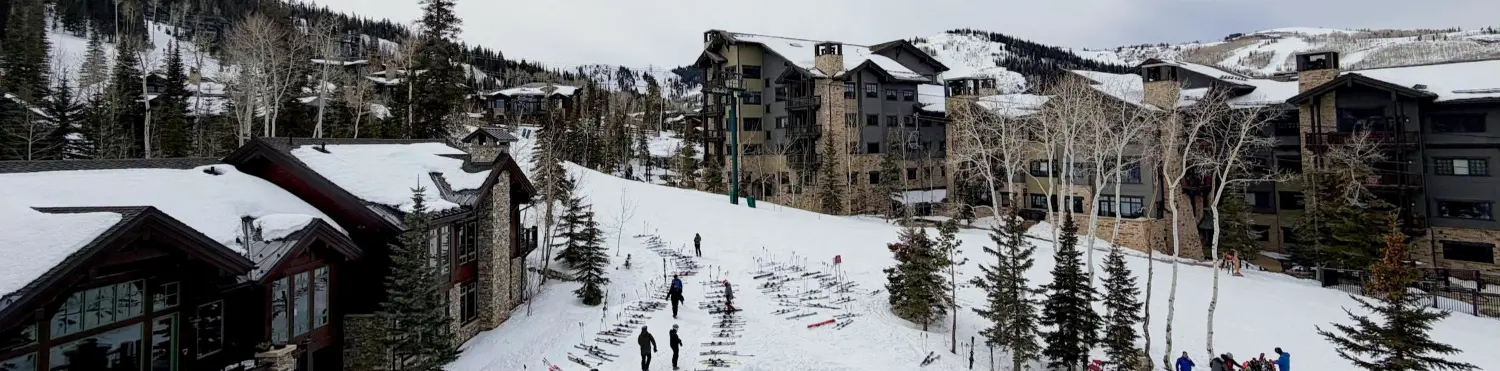
Traditional Deer Valley is the resort as longtime owners know it — Snow Park Lodge, Silver Lake Village, and the established neighborhoods of Upper Deer Valley, Lower Deer Valley, Deer Crest, and Empire Pass. These areas carry decades of ownership history, mature landscaping, and direct access to the original six mountains and 103 runs that defined the Deer Valley experience.
Both sides of the resort now share the same lift system, the same limited daily skier count, and the same brand. That is the detail that matters most to property values.
Why the Expansion Is Lifting Values Across All of Deer Valley
When a Four Seasons, a Waldorf Astoria, and a Grand Hyatt all choose to build within a single village — and a developer commits $5 billion to the project — it sends a signal to every buyer evaluating Deer Valley real estate. The signal is simple: the institutional money believes this market is undervalued relative to where it is going.
That confidence does not stay contained on one side of the mountain. It reprices the entire resort.
Consider what happened in 2025. Empire Pass saw 10 closed sales, with a median price increase of 12 percent, pushing the median price to $14.5 million. Upper Deer Valley recorded a 4 percent increase in median price to $7.4 million. Deer Crest held steady at a $12 million median on limited sales. Even Lower Deer Valley, which saw a slight 1 percent dip to $4.3 million, continues to hold strong relative to the broader Park City luxury market. Across the Greater Park City area, property values have historically doubled in approximately 51 months — significantly faster than the national average.
The expansion is accelerating that trajectory for one reason: it is compressing supply against rising demand. Deer Valley was already land-constrained. The original resort neighborhoods are largely built out. There is very little remaining inventory in Deer Crest. Empire Pass has limited available homesites. The expansion does not add supply to those areas — it adds demand by bringing a new population of buyers to the Deer Valley brand who then compare Traditional Deer Valley pricing to what they are seeing on the Contemporary side.
When a buyer sees a new-build Four Seasons residence priced at $10 million to $14.5 million and then looks at an existing ski-in/ski-out home in Empire Pass or an estate on Deer Crest at comparable or lower pricing, the calculus shifts. Traditional Deer Valley suddenly looks like relative value — and that perception moves prices.
The Infrastructure Effect
The expansion has also introduced infrastructure that benefits the entire resort. The new base area off Highway 40 provides 1,200 additional day-skier parking spaces — a direct relief valve for congestion at Snow Park. There are no traffic lights between Salt Lake City International Airport and the new village entrance, a meaningful access advantage for fly-in buyers. The snowmaking system added over 1,200 snow guns, 350,000 feet of pipeline, and three new pump houses — coverage that extends across the expanded terrain but supports overall snow quality resort-wide.
For property owners in Traditional Deer Valley, this means the resort experience is improving without any change to their immediate neighborhood. The terrain is bigger, the access is better, the global profile is higher, and the daily skier cap remains in place. That combination directly supports long-term property values.
What History Tells Us About Resort Expansions and Property Values
Deer Valley is not the first major ski resort to undergo a large-scale transformation. Two precedents are worth examining — one of which played out right here in Park City.
In 2014, Vail Resorts acquired Park City Mountain Resort for $182.5 million and announced it would connect PCMR with neighboring Canyons Resort, creating the largest ski area in the United States. The real estate market responded almost immediately. In the six weeks following the acquisition announcement, Park City saw a 43 percent year-over-year increase in pending property sales and a 71 percent surge in condo transactions. Ultra-luxury ski-in/ski-out homes near the Canyons base jumped 20 to 25 percent overnight. The effect did not fade. Between 2012 and 2016, Summit and Wasatch County property values climbed at an annualized rate of 7.5 percent, with buyers who felt priced out of the resort core pushing demand into surrounding areas like the Heber and Kamas Valleys. The lesson: when institutional capital enters a resort market at scale, it reprices the entire region.
A similar pattern played out in Whistler, British Columbia. When Vancouver was named host of the 2010 Winter Olympics and billions in infrastructure investment followed — upgraded gondola systems, new venues, expanded conference facilities — Whistler property owners who had purchased in 2000 saw as much as $700,000 in equity gains by 2003, well before the Games even took place. The long-term trajectory has been equally strong. Average sale prices in Whistler have increased approximately 35 percent since 2020, with price per square foot rising from $800 to over $1,100 by 2025. Whistler's appreciation has averaged 6 to 8 percent annually over the past decade, supported by the same dynamics at work in Deer Valley: constrained land supply, global brand recognition, and sustained infrastructure investment.
The Deer Valley expansion is a larger capital commitment than either of those events. A $5 billion development with three globally recognized hotel brands, more than doubling the skiable terrain, and a new base village built from the ground up — this is not a lift upgrade or a marketing rebrand. It is a generational transformation. If history is any guide, the effect on surrounding property values is not a question of whether, but of how much.
What This Means for Buyers and Sellers Right Now
If you own in Traditional Deer Valley, the expansion is working in your favor. The entry of global hospitality brands and the scale of new development are raising the floor for what Deer Valley real estate is worth. As the Four Seasons and Waldorf Astoria come online in 2028, expect the pricing conversation to shift further. These are not mid-market products. They are setting new ceilings for the entire resort, and those ceilings lift everything underneath them.
If you are considering a purchase, the question is where you want to be positioned. Contemporary Deer Valley offers new construction, modern architecture, and resort-managed amenities with direct gondola access to over 4,300 acres of terrain. Traditional Deer Valley offers established neighborhoods, proven rental performance, proximity to Park City's dining and cultural scene, and — in many cases — pricing that looks increasingly attractive against the new inventory.
Both are Deer Valley. Both carry the same brand, the same mountain access, and the same limited daily skier policy. The difference is in the ownership experience you are looking for.
Frequently Asked Questions About the Deer Valley Expansion and Real Estate
How large is the Deer Valley expansion?
The expansion has added more than 2,300 acres of new terrain, 10 new chairlifts, and nearly 100 new ski runs to the resort. Deer Valley has grown from approximately 2,000 skiable acres to over 4,300, with the full buildout expected to reach 5,726 acres. It is the largest ski resort expansion in North American history.
What is Contemporary Deer Valley?
Contemporary Deer Valley is a term used to describe the new expansion side of the resort — the village and surrounding development accessed off Highway 40. It includes the Grand Hyatt Deer Valley, the incoming Four Seasons Resort and Residences, the announced Waldorf Astoria, and residential developments like Cormont, Marcella Landing, and Marcella Estates. The architecture is modern, the infrastructure is new, and the hotel brands are global.
What is Traditional Deer Valley?
Traditional Deer Valley refers to the original resort footprint — Snow Park Lodge, Silver Lake Village, and the established neighborhoods of Upper Deer Valley, Lower Deer Valley, Deer Crest, and Empire Pass. These areas carry decades of ownership history, mature communities, and direct access to the original six mountains that defined the Deer Valley experience.
How is the expansion affecting property values in existing Deer Valley neighborhoods?
The expansion is applying upward pressure on values across all established Deer Valley neighborhoods. In 2025, Empire Pass saw a 12 percent increase in median price to $14.5 million, Upper Deer Valley rose 4 percent to $7.4 million, and Deer Crest held steady at $12 million. The introduction of globally branded hotel residences priced from $2.3 million to $14.5 million is establishing new pricing benchmarks that make Traditional Deer Valley look like relative value.
What hotel brands are part of the new development?
Three major hotel brands have committed to the expansion. The Grand Hyatt Deer Valley opened in late 2024 with 381 hotel rooms and 55 private residences (sold out, priced $2.3M to $6.9M). The Four Seasons Resort and Residences is projected for 2028, with 134 guest rooms and 123 private residences ($5.1M to $14.5M). The Waldorf Astoria Deer Valley is also projected for 2028, with 132 guest rooms and 105 residences.
Will the expansion change the daily skier limit at Deer Valley?
No. Deer Valley has confirmed that daily skier capacity limits will remain in place despite the expanded terrain. This is a significant factor for property values because it preserves the uncrowded ski experience that defines the Deer Valley brand.
Is the expansion accessible from the original Deer Valley base areas?
Yes. The new terrain is fully integrated into Deer Valley's trail network and is accessible from multiple routes off the east and south sides of Bald Mountain. The new base area off Highway 40 also provides 1,200 additional parking spaces and a direct, stoplight-free route from Salt Lake City International Airport.
How does the Deer Valley expansion compare to other major ski resort transformations?
The scale exceeds recent precedents. When Vail Resorts acquired Park City Mountain Resort in 2014 and invested $50 million, Park City saw a 43 percent increase in pending sales within six weeks. Whistler's Olympic-era infrastructure investment drove property appreciation of 6 to 8 percent annually for over a decade. The Deer Valley expansion represents a $5 billion commitment — significantly larger than either — suggesting the long-term impact on property values could be proportionally greater.
Properties and Resources
For a closer look at available inventory across all five Deer Valley areas, visit our Deer Valley Real Estate page. For listings in the expansion area, see our Deer Valley Expansion Real Estate page. For new construction options across the resort and beyond, see our Deer Valley New Construction guide. For current market data, our Deer Valley Real Estate Trends report tracks price per square foot, days on market, and inventory on a month-by-month basis.
If you are evaluating a purchase or considering the timing of a sale in any Deer Valley neighborhood, let's have a direct conversation. Reach out when you are ready.
About the Author
Derrik Carlson leads REAL ESTATE IN PARK CITY, specializing in luxury and ski-in/ski-out properties across Deer Valley, The Colony at White Pine Canyon, Promontory, and Empire Pass. With nearly 20 years in real estate and a focus on properties above $10 million, Derrik advises buyers and sellers navigating Park City's most competitive market segments. His team includes buyer and seller agents Lana Harris and Grayson West, with Shelby Sisson managing operations and support.
Derrik Carlson
REAL ESTATE IN PARK CITY
435.200.5478
realestateinparkcity.com
Enjoy this blog post? Click here to subscribe for updates
Leave A Comment